Longitudinal support stability
The same protocol at Year 2 yields a cross-visit support replication score of 0.928 ± 0.033, based on support-set Jaccard overlap, with a mean overlap of 2.86 of 3 nodes.
NeurIPS 2026 Poster
1 Department of Biostatistics, Yale School of Public Health, Yale University
2 Department of Statistics and Data Science, University of Texas at San Antonio
3 School of Statistics, University of Minnesota, Twin Cities
At a glance. OSSA finds small sets of brain regions whose anatomical wiring aligns with how those regions function together. In the ABCD Study, it improved alignment on held-out participants compared with size-matched baselines, and the selected regions were consistent at the two-year follow-up.
Characterizing the relationship between brain anatomical wiring and functional coordination remains a fundamental challenge in computational neuroscience. This difficulty primarily arises because structure-function coupling in the human brain is spatially heterogeneous, often localized to subnetworks, and inherently difficult to align across disparate representational modalities.
To address this methodological gap, we introduce Orthogonal Sparse Subgraph Alignment (OSSA), a principled and interpretable framework designed to identify compact structural cliques that exhibit maximal concordance with functional connectivity (FC) across subjects. Within each FC-derived community, OSSA optimizes an alignment objective over an orthogonal transformation, which absorbs coordinate mismatch between the two connectivity modalities, and a sparse node-selection vector, which identifies the induced structural connectivity (SC) subgraph.
Furthermore, for canonical OSSA within a fixed population community, we establish local statistical guarantees under the required assumptions. With high probability, an empirical local maximizer exists in a specified neighborhood of the population target, and every local maximizer in that neighborhood exactly recovers the active support and satisfies a nonasymptotic error bound for the aligned functional projector.
Extensive empirical evaluations on simulated data, alongside analyses of the Adolescent Brain Cognitive Development (ABCD) baseline and longitudinal cohorts, demonstrate that OSSA successfully recovers aligned structural cliques under latent cross-modal rotations. Ultimately, the proposed methodology significantly improves out-of-sample SC–FC alignment over size-matched baselines and identifies compact structural supports with longitudinal consistency in node selection, while multi-support diagnostics suggest a dominant aligned core within the estimated FC communities.
OSSA extends orthogonal Procrustes alignment to a setting where the target subgraph is unknown. It identifies functional communities from training data, then learns an orthogonal transformation and selects a small set of structural nodes jointly within each community.
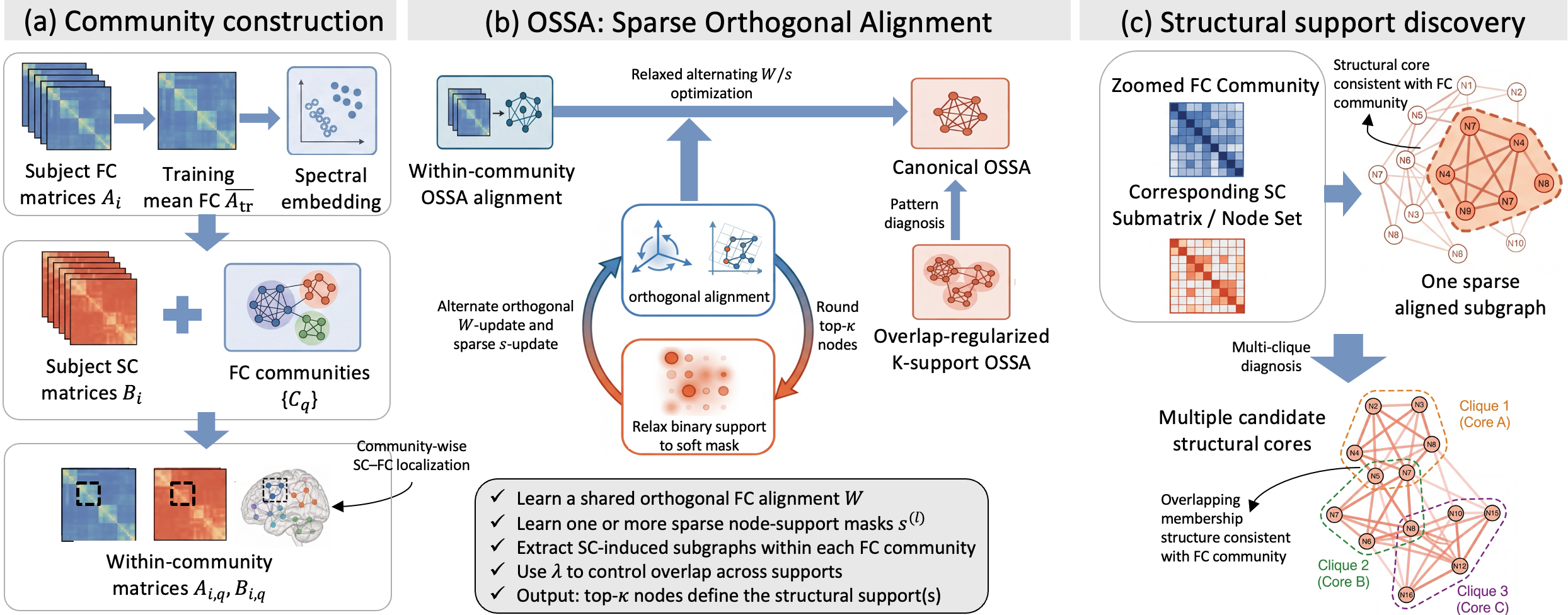
OSSA improved structure–function alignment on held-out participants compared with size-matched baselines. At the two-year follow-up, the selected subnetworks shared an average of 2.86 of 3 nodes with the baseline selections.
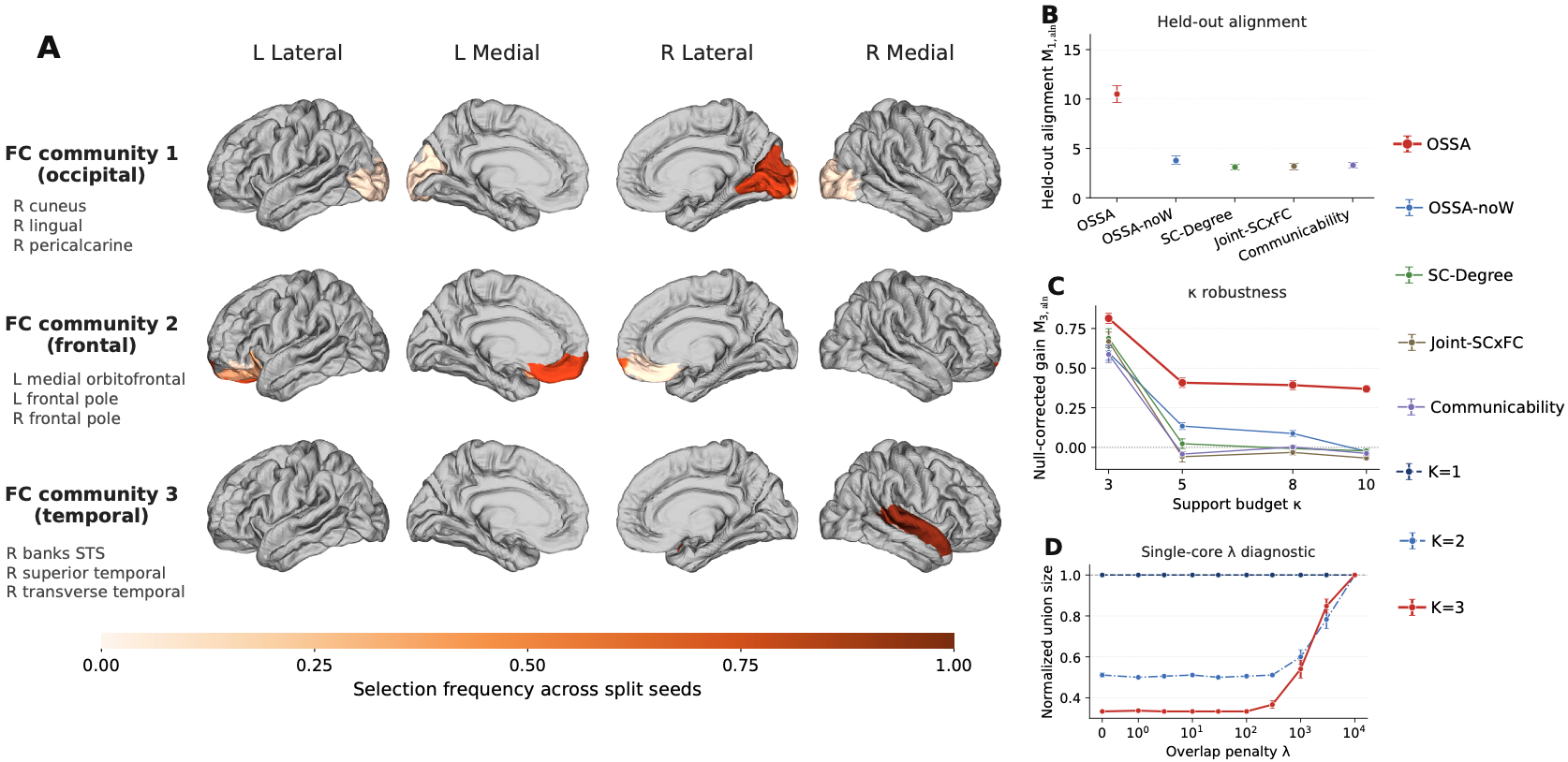
The analysis uses the 68-region Desikan–Killiany atlas and 60%, 20%, and 20% training, validation, and test splits across ten seeds. OSSA is compared with fourteen size-matched baselines and an ablation that fixes the rotation to the identity. Each baseline support is evaluated with its own rotation fitted on training data.
| Method | Held-out alignment |
|---|---|
| OSSA | 10.55 ± 0.85 |
| NMF | 9.96 ± 0.82 |
| Sparse PLS | 9.22 ± 1.10 |
| OSSA-noW | 3.82 ± 0.42 |
Comparisons across repeated splits are descriptive: the splits reuse subjects from the same cohort. Complete baseline results and evaluation details are in the paper.
The same protocol at Year 2 yields a cross-visit support replication score of 0.928 ± 0.033, based on support-set Jaccard overlap, with a mean overlap of 2.86 of 3 nodes.
The multi-support diagnostic suggests a dominant aligned core within the estimated FC communities: additional supports collapse at small penalties, while forcing them apart lowers the primary held-out alignment objective.
The selected regions depend on the functional-community construction, sparsity budget, atlas, and cohort. Longitudinal support stability alone does not establish biological specificity.
Reference
@inproceedings{gao2026orthogonal,
  title = {Orthogonal Sparse Subgraph Alignment for
           Structure-Function Coupling in Brain Networks},
  author = {Gao, Haonan and Ham, Daeyoung and Zhang, Yifei and
            Tian, Xinyuan and Ding, Shengxian and Zhao, Yize and
            Li, Tianxi},
  booktitle = {40th Conference on Neural Information
               Processing Systems (NeurIPS 2026)},
  year = {2026},
  url = {https://rampageoppa.github.io/projects/ossa/}
}